
Criminal Cases in the Monroe County Courts
Monroe County belongs to Missouri’s Tenth Judicial Circuit with Marion and Ralls counties. The Circuit Court has original jurisdiction over felony cases. Its associate circuit division handles many misdemeanors and the early parts of felony matters, including proceedings before a felony case advances. Municipal divisions deal with ordinance cases. The venue printed on a ticket or court notice controls, so a city citation should not be treated as a Monroe County state criminal case without checking the assigned court.
The Monroe County Circuit Clerk is the custodian of felony, misdemeanor, traffic, and other circuit records. The clerk maintains the docket and filed documents; the prosecutor chooses the formal charges; the sheriff keeps arrest and booking records. Those offices may share the Paris courthouse, but their records do not merge. A request for the filed information, judgment, or certified disposition belongs with the clerk, while a request for an officer’s narrative belongs with the agency that wrote it.
Monroe County Criminal Clerk Counter
The Monroe County Circuit Clerk works at the courthouse at 300 N. Main St., Paris, MO 65275. Counter hours are Monday through Friday, 8:00 a.m. to 4:30 p.m. The main number is 877-433-3061, extension 425, and the fax is 660-327-5781. Call with the full case number when possible. Ask the clerk about copies, certification, an older file, a docket entry that lacks an online image, or the access status of a case that does not appear online.
Monroe County Circuit Clerk
300 N. Main St.
Paris, MO 65275
877-433-3061 ext. 425
Monday-Friday, 8:00-4:30
No official Monroe County plain-copy, certified-copy, archive-retrieval, or staff-search fee was published in the researched clerk material. Ask for the current amount before ordering. The clerk, not an online screen, supplies the authoritative certified record when proof of a disposition is needed.
How to Search Case Records
Missouri Case.net is the free public starting point for Monroe County criminal case records. It provides a statewide index and docket view after acceptance of its terms. Search by court case number when one is available because it separates the right file from people with similar names. A name search needs more care: spelling, middle names, filing year, court location, and case type can all change which results appear.
- Accept the Case.net terms and select the litigant-name or case-number search.
- Enter the party’s name, or use the court-assigned number for the strongest match.
- Choose Monroe County or the Tenth Judicial Circuit, then narrow by criminal case type and filing year.
- Open the result and read charges, docket events, hearings, financial entries, and each count’s disposition.
- Give the case number to the Circuit Clerk when a document image, archived item, or certified copy is required.
The main fields captured from the official Case.net interfaces are shown below. Some controls vary by search route.
| Field Label | Type | Required | Notes |
|---|---|---|---|
| Last Name | Text | Yes, name route | Spelling and aliases matter |
| First / Middle Name | Text | No | Narrows a common surname |
| Year Filed | Dropdown or text | No | Helps isolate older dockets |
| Case Type | Dropdown | No | Choose criminal, traffic, or municipal as needed |
| Court / Location | Dropdown | No | Select Monroe County, Tenth Circuit, or statewide |
| Case Number | Text | Yes, number route | Use the court-assigned format |
Filtering Monroe County Criminal Cases
The official Case.net litigant search shows why both the court filter and party fields matter.
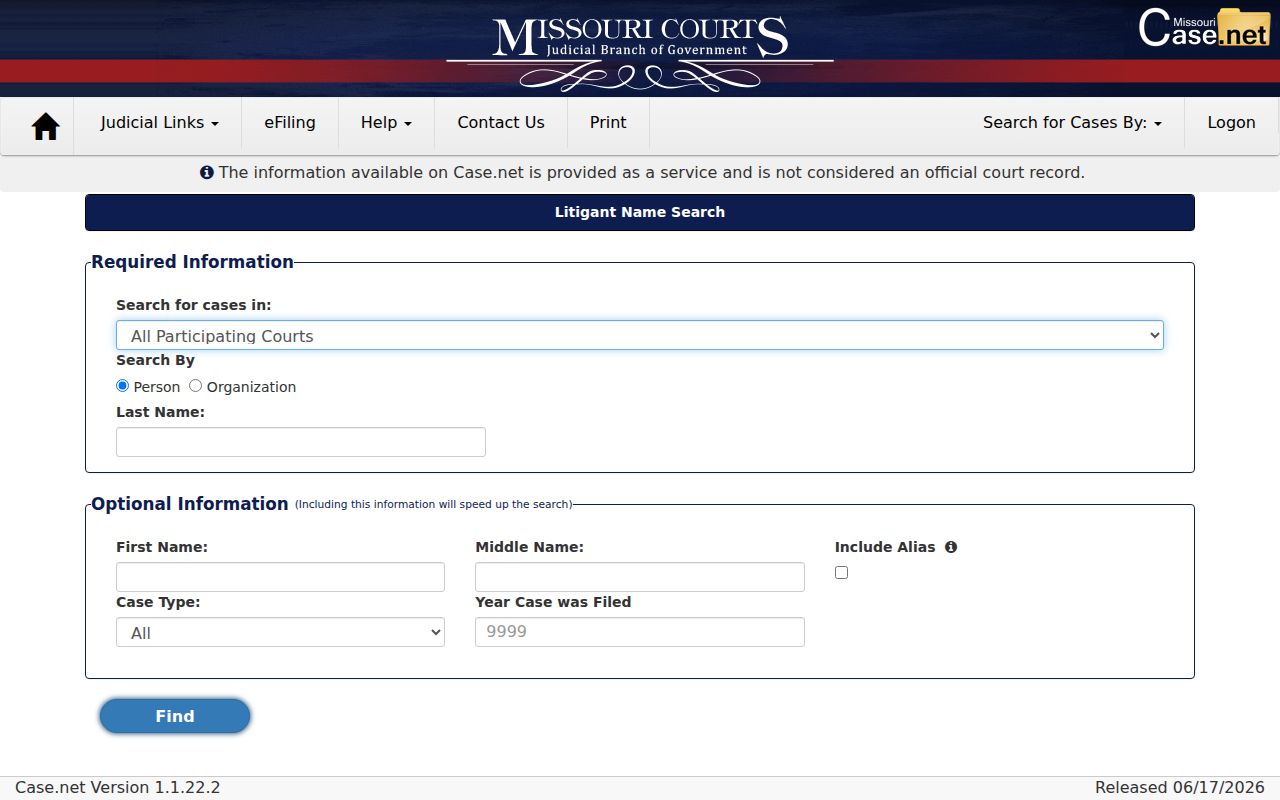
The interface supports a broad name search, but a broad hit is only a lead. Open the matching Monroe County docket and compare its filing details before linking a record to a person.
Case.net warns that its entries are not the official court record and may change. Public document images vary. Closed cases, confidential papers, and protected details will not appear like an ordinary public docket. A screen capture may help locate a file, but it is not a certified judgment.
What the Case File Shows
A Monroe County court file follows formal accusations and the court’s response to them. Read the case header first, then inspect every count. One count may be dismissed while another ends in a plea or trial judgment. Docket events show what occurred in sequence, while the judgment and sentence establish the outcome.
| Case Number & Court | The unique file identifier, assigned location, filing date, case type, status, and case style. |
|---|---|
| Charging Document | The complaint, information, or indictment stating the formal accusation used in court. |
| Charges | Each count’s description, statute, level or class, relevant date, and separate disposition. |
| Docket Entries | A dated register of filings, warrants or summonses, pleas, motions, hearings, orders, and later compliance events. |
| Hearing Dates | The scheduled date, time, type, place, and assigned judge when publicly shown. |
| Disposition & Judgment | The result for each count, such as conviction, dismissal, acquittal, or a prosecutor’s decision not to continue. |
| Sentence & Financials | Custody, probation, conditions, fines, costs, and payment entries when public. |
Protected identifiers, victim or minor information, and sealed material are redacted or withheld. Docket descriptions may remain visible even when the related document image cannot be opened remotely.
Reading Monroe County Case Outcomes
Case status and count disposition answer different questions. An “open” or “closed” label describes the file’s broad state, but each charge may have its own result. A dismissal means no conviction on that count. Nolle prosequi records the prosecutor’s choice not to continue a charge at that time. An acquittal is a not-guilty finding. A conviction is a judgment of guilt after a plea or trial.
- Disposition
- The recorded outcome of a charge or case.
- SIS
- Suspended imposition of sentence, which withholds imposition while the person completes court conditions or probation.
- SES
- Suspended execution of a sentence already imposed, with different judgment and record effects from SIS.
- Docket
- The court’s dated register of filings and events.
- Arraignment
- The hearing where the accused is advised of the filed charge and enters a plea.
SIS is not the same as expungement. Successful completion can close a record under Missouri law, but expungement is a separate court process. When the outcome matters, obtain the certified disposition from the Monroe County Circuit Clerk and read it count by count.
Stages of a Criminal Case
A Monroe County case can begin with an investigation or arrest, but the court record takes shape when the prosecutor files a complaint or information, or a grand jury returns an indictment. An associate circuit judge may handle probable-cause and initial proceedings. The accused is then arraigned. Discovery, motions, and hearings prepare the case for a negotiated plea or trial. Judgment records the result, and sentencing sets the consequence after a conviction.
Case flow: Charges Filed › Arraignment › Pretrial › Plea or Trial › Disposition › Sentencing
Booking claims can change before filing. The prosecutor decides which counts reach court, and the judge rules on the case. For that reason, the filed Monroe County case and its final disposition provide a different record than the Monroe County arrest history.
Missing Monroe County Criminal Cases
No Case.net result does not always mean no court record exists. A name may be spelled differently, the search may use the wrong filing year, the case may sit in another county, or a municipal matter may use a different channel. A very recent arrest may not yet have produced a filed charge. A confidential, juvenile, closed, or expunged record may also be absent from ordinary public search.
Try a case number first. Then adjust the name, year, case type, and location. Monroe City spans more than one county, so the city name alone does not prove that Monroe County is the right court filter. If a citation names a municipal division, follow that notice. When a known Monroe County file remains missing, call the clerk with the party name and approximate filing date. The clerk can explain the public access status without disclosing material that law keeps closed.
Access & Restrictions
Missouri Court Operating Rule 2 governs public access to court records, including remote electronic access and confidential information. The Missouri courts’ access rule works alongside the Missouri Sunshine Law. Court confidentiality, juvenile protections, victim safeguards, and a valid closure or expungement order can limit what the public sees. A public request cannot override those rules.
Use Case.net for the public index and docket. Use the clerk for public copies, certification, archive questions, and help identifying the proper access route. Ask for the legal basis if access to an identifiable public record is denied. The clerk cannot supply a police narrative held by the sheriff, and the prosecutor is not the custodian of the court file.
Monroe County Criminal Court Rules
The Tenth Judicial Circuit’s local rules cover Marion, Monroe, and Ralls counties. This three-county structure can affect assignments and procedure, so readers should not assume the Monroe County court works like a one-county urban system. The statewide court directory and local rules describe the judicial structure; the docket and clerk identify what applies in one case.
The court file remains local even when a state system displays it. Case.net is the search layer. The Monroe County Circuit Clerk is the records custodian. MSHP’s Central Repository holds a separate statewide criminal-history product, and neither replaces the certified case file. Keeping those roles distinct prevents a name-search result, an arrest cycle, or a docket status from being treated as the final judgment.